The European Journal of Political Research has put together a virtual special issue that “provides a cross-section of where cutting edge qualitative research works today”. Happily, my paper, entitled “Inequality, marketisation, and the left: Schools policy in England and Sweden”, has been included in it. It’s a nice initiative, with the nice bonus that the paper will now be freely available for the next 12 months.
Category: Uncategorized
SASE mini-conference on “The Politics of Egalitarian Policy”
Lucy Barnes and I are organizing a mini-conference on “The Politics of Egalitarian Policy” as part of the SASE 2015 conference in London this July (2nd-4th, 2015).
We’d like to encourage people working in this area to submit a paper or panel proposal. We welcome submissions on any political aspect of inequality, particularly those centred on the themes listed below. If you have any questions, please do feel free to email Lucy or me.
N.B. The application deadline is January 26th. There are instructions about how to submit. You need to be logged-in to the SASE website to submit a paper/panel, but you need not pay the full membership fee to get a login.
The themes we are interested in follow below…
Information
What do voters know about government efforts to reduce inequality? Are some voters more informed about redistribution than others, and why? How do the media affect voters’ information and perceptions of egalitarian policy?
Preferences
How do voters think about government efforts to reduce inequality? What kinds of policy interventions garner popular support? What are the electoral implications of these popular attitudes? (How) do these vary across countries?
Pre-distribution
What influence can governments have on the distribution of market (‘pre-fisc’) incomes? What kinds of policies – aside from tax and transfer redistribution – can reduce inequality?
Partisan politics
How does partisan politics shape distributive policy, and vice versa? Under what conditions, and in which policy areas is there scope for partisan discretion? Conversely, what effects does increasing inequality have on partisan politics?
International Issues
What effects do international dynamics – war, globalisation, international institutions and processes of competition and diffusion – have on government efforts to combat inequality? How should issues of inter-country inequalities inform policy and scholarship on income inequalities?
The Politics of Academy Conversion Amongst English Schools
The ‘academization‘ of the English schooling system has been much-remarked, but there has been relatively little systematic work studying the politics of this process. In a new paper, forthcoming at Public Administration, I document both the magnitude of the phenomenon of academy conversion and some intriguing features of its underlying politics.
On the magnitude of the change that is underway, the figures are rather stark. Using data from January 2013, one third of secondary schools had converted by only the third year of the push by Michael Gove and the coalition government to foster this change.
I use data from an FoI request (provided by The Guardian) regarding which schools expressed an interest in converting to academy status to show that there is a marked political gradient to these expressions of interest. This can be seen clearly in a raw bivariate correlation (below) of the (binned) Conservative-minus-Labour vote share of Westminster constituencies in which schools are located and the proportion of them that expressed interest in conversion. Schools in more strongly Conservative constituencies are much more likely to be interested in converting. (The relationship also easily survives in multivariate analysis.)

Perhaps more importantly, these expressions of interest clearly drove the same pattern in actual conversions to academy status, as well.
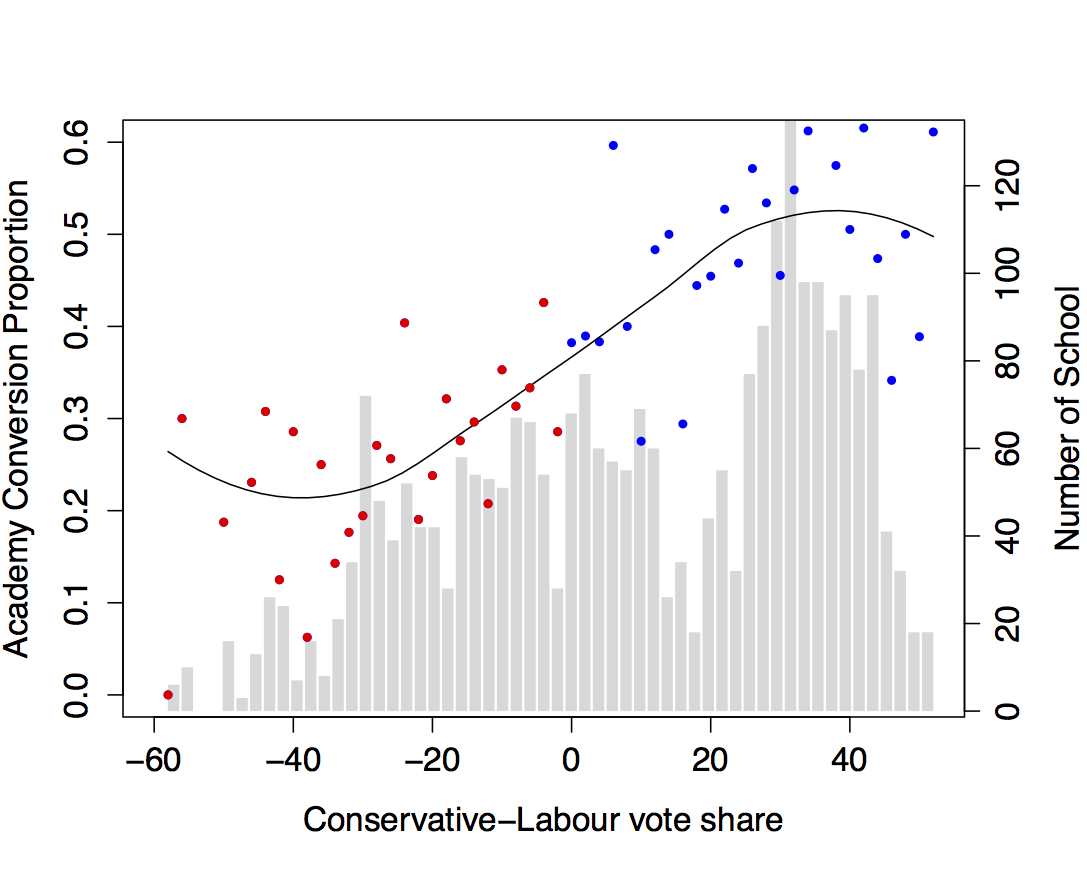
There is strong evidence of a political effect from the application side, but I find no discernible political effects of the DfE decisions regarding whether to authorize conversions. (Full details in the paper.)
Meanwhile, I do find evidence that schools that find themselves in more strongly Conservative-voting constituencies but under a Labour-controlled LEA are particularly likely to convert. Conversely, schools in more strongly Labour-voting constituencies and under a Labour-controlled LEA are less likely to convert. It appears that schools may be using academy conversion as a way of avoiding “governance” from above that comes with a partisan flavor that does not fit with the more local political environment.

For much more detail, see the pre-publication draft of “Partisan Governance and Policy Implementation: The Politics of Academy Conversion Amongst English Schools“.
New conference paper: “Class-Biased Economic Voting in Comparative Perspective”
I have a new paper (together with Alan Jacobs and Scott Matthews) that looks at the interaction between income inequality and vote choice in comparative perspective. This was presented at the APSA conference (Chicago, Aug/Sep 2013) at rather a good panel.
This is ongoing research, but the conference draft is available via SSRN. Comments are extremely welcome.
Here’s the abstract:
A growing literature has inquired into the political consequences of rising income inequality in the United States. Scholars have identified a number of mechanisms through which American democracy has become more responsive to the interests of the very rich than to the those of lower- and middle-class citizens. Among the patterns of unequal influence that analysts have observed is a strong “class bias in economic voting” identified by Bartels (2008). Specifically, Bartels finds that lower- and middle-class voters are far more responsive to election-year income growth among the richest Americans than they are to overall economic growth or to growth within their own income brackets. In this paper, we examine this troubling feature of U.S. electoral politics in comparative perspective, asking (i.) how widespread class biases in economic voting are in advanced democracies and (ii.) what generates them. Analyzing electoral behavior in three OECD countries (Canada, Sweden, and the United Kingdom), we find clear evidence of class-biased economic voting with substantively important electoral consequences outside the United States. Most surprisingly, we find that the class bias is not limited to national contexts characterized by market-liberal norms and institutions. We then propose two possible mechanisms that might contribute to the class bias — an informational mechanism and an ideological mechanism — and test for their operation in the United States and Sweden. The results are highly consistent with the operation of both mechanisms in the United States and weakly suggestive of an informational effect in Sweden.
Partisan Strategy and Path Dependence: The Post-War Emergence of Health Systems in the UK and Sweden
I have a paper just published in ‘Comparative Politics’. Get your ‘official’ copy via IngentaConnect or your ‘unofficial’ copy via SSRN.
Here’s the abstract:
Why did a highly redistributive, nationalized health care system emerge in the UK, where the Left was comparatively weak, while a more redistributively neutral, cash-centric, insurance-based system was pursued in Sweden, where the Left was strong? The explanation is two fold. First, in contrast to the Swedish Social Democrats, the weakness of the British Labour Party constrained it to pursue redistribution via health policy. Second, given the redistributive goals of the National Health Service, it became imperative for the Labour Party to construct a system that would be difficult for future Conservative governments to retrench. More generally, this formulation posits rational actors operating in the kinds of processes typically studied by historical institutionalists. The result is a tendency for a type of path dependence by design.
Op-eds to consider
For those in my PO4730 class pondering what to write their op-ed assignment on, here are a few pieces that you might find inspiration from. The idea is to respond as a social scientist, of course.
- John Kay (FT) arguing that “Corporate tax should be fair and shared“
- Paul Johnson (FT) arguing “If you want to tax the rich, do it fairly“
- Sean Coughlan (BBC News) on how “Downward mobility haunts US education“
- Kathleen Lynch (UCD) arguing “Charity no substitute for action on inequality
- Vincent Browne (Irish Times) on “Why the American dream is just a mirage“
- Elaine Byrne (Irish Independent) arguing that “It’s class warfare they want, not private education cuts“
- Seamus Milne (Guardian) on “A roll call of corporate rogues who are milking the country“
- Ian Jack (Guardian) asking “Why are our attitudes to poverty at home and abroad so different?“
- Gavin Kelly (Guardian) arguing that “George Osborne’s strivers have a shock in store“
- Kelvin McKenzie (Telegraph) arguing that “overtaxed South needs its own party“
- (Updated 2012/12/4) Robert Skidelsky (Social Europe) arguing that “Inequality is Killing Capitalism“
Comparative data on university enrolment
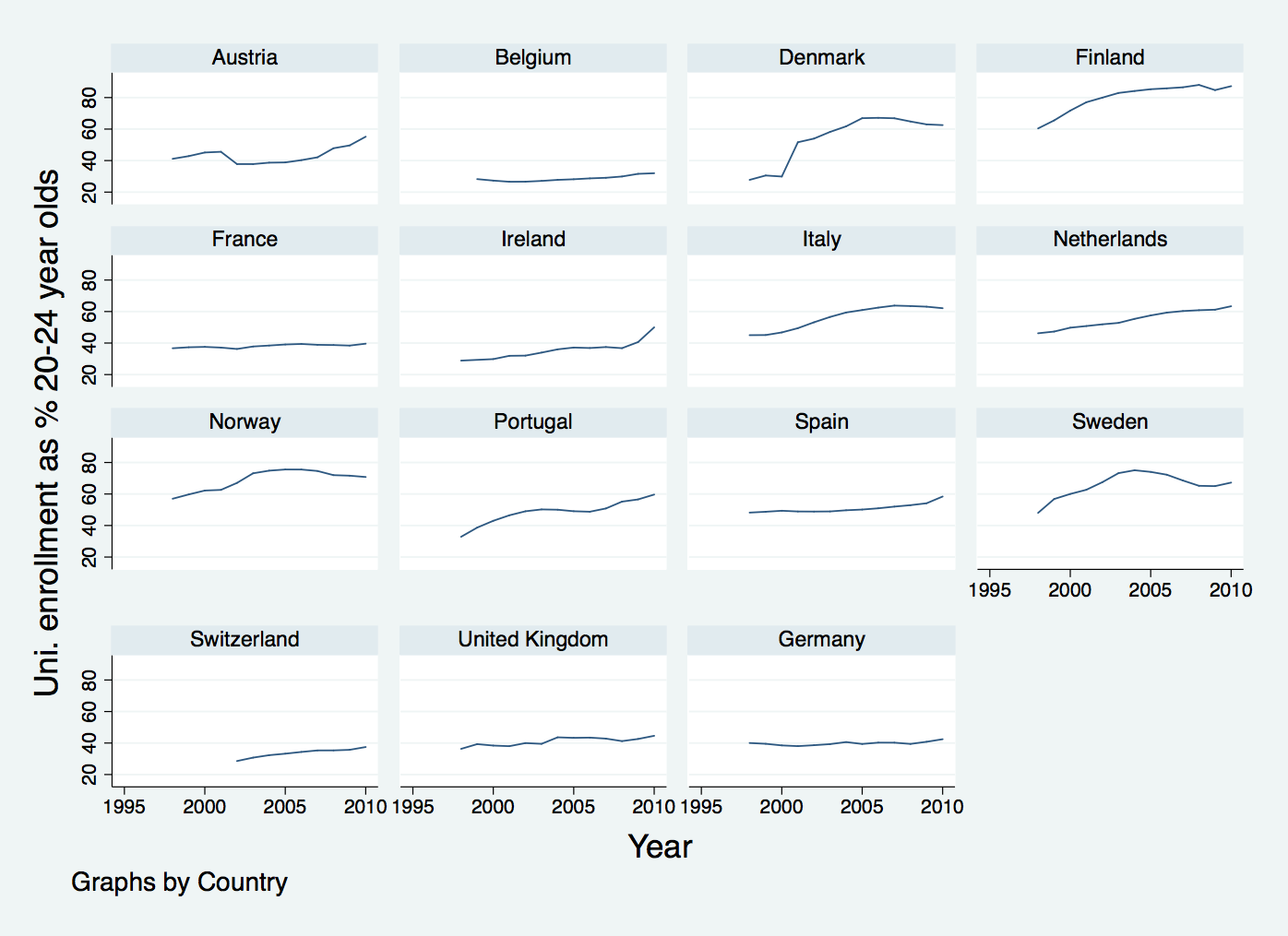
We were discussing the causes of ‘market inequality’ in class today. Amongst other things, we discussed the importance of skill-biased technological change. This led some people to wonder what the comparative data looks like on higher education enrolment across countries. If there is rising demand for skilled workers, have some countries been better at meeting this demand than others?
I wondered, and so went to the Eurostat web site. From the ‘Population and social conditions’ theme, I got hold of what seems like a reasonable proxy for university enrolment figures from the ‘Education and training’ section, and then figures for the number of people in the 20-24 age cohort for each country. Taking the ratio of the two, multiplied by 100, I then calculate an (approximate) enrolment rate for each country.
Without further comment on the reliability of the calculations or what the appropriate inferences are, I offer, below, the plots for these data for the countries that seem to be of most direct interest for the class. (No population data available for the USA from Eurostat, I’m afraid. I’m sure it’s available elsewhere, but I’m not going to look for it.)
If you would like to look at the original data and/or see the Stata code that merges it and then generates the plot, try the following: pop2024.csv, unienrol.csv, and highereducation.do.
Red State, Blue State 2012 Links
Last week was “Red State, Blue State” (“What’s the Matter with Kansas?” week in The Politics of Inequality class. Here are a few readings/listenings that bring things up to the present day:
- The This American Life take on Red State Blue State
- Peter Kelner (YouGov) on “How Obama won“
- Gabriel Lenz (Berkeley) answering whether “Mitt Romney’s Conservative Shift Hurt or Help Him in the General Election?“
- Simon Jackman (Stanford) on How Obama won: the swing state swings“
- Andrew Gelman (Columbia) saying that “richer people continue to vote Republican“
- Andrew Gelman saying that “The Republicans are the party of the middle class and rich; the Democrats are the party of the poor, middle-class, and rich“
- Andrew Gelman and Avi Feller with “Red-blue maps for different slices of the population“
- Robert Vanderbei (Princeton) with 3D maps of vote choice
“Pay over the last 25 years” from the ONS
(Hat tip to Mark Pack at Lib Dem Voice.)
Assorted politics of inequality links
My ‘Politics of Inequality’ (PO4730) class has been talking about a variety of things in the past five weeks that have found recent expression on the web.
- John Rentoul on The Rich Don’t Get Richer, providing some opinion and data on the British wealth distribution.
- John Rentoul (again) on Vince Cable and social mobility, making a point about the need for conceptual clarity (on the latter) as well as related policies.
- Tyler Cowen providing a pointer to a study on Surnames and the laws of social mobility.
 Timothy Hicks